Brendan M. O'Connor

Brendan O'Connor
Astrophysicist
Neil Gehrels Fellow
Joint Space-Science Institute
University of Maryland College Park
About Me
Hi, I'm Brendan. I am a Neil Gehrels Fellow at the University of Maryland studying cosmic explosions. My research is in the field of time domain and multimessenger (TDAMM) astrophysics. In particular, I am interested in the formation and evolution of high energy transients and the extreme stellar systems that produce them. This includes the relativistic outflows that produce gamma-ray bursts and fast X-ray transients, including phenomena associated with the deaths of massive stars and the mergers of compact objects. I use a variety of multiwavelength observatories across the electromagnetic spectrum (e.g., Gemini, Chandra, HST, JWST) to investigate the physical mechanisms that power these transients and constrain the properties of their progenitors and environments.
I received my PhD from The George Washington University in 2023. Prior to moving to Maryland, I was a McWilliams Fellow at Carnegie Mellon University.
 |  |  |  |  |
|---|---|---|---|---|
 |  |  |  |  |
 |  |  |  |  |
 |  |  |  |  |
Research
• Time Domain and Multimessenger Astronomy
• Gravitational waves
• Neutron star mergers and kilonovae
• Gamma-ray bursts and their host galaxies and environments
• Fast X-ray Transients, X-ray Flashes, and Explosive Transients
• Supernova Shock Breakout
• Surveys and serendipitous transients
• Galactic X-ray transients: magnetars, cataclysmic variables, high-mass X-ray binaries
Gamma-ray Bursts
Gamma-ray Bursts (GRBs) are bright flashes of gamma-rays detected by space satellites. I am very interested in short GRBs, which have a prompt gamma-ray duration less than 2 seconds. These bursts are caused by the coalescence and cataclysmic merger of a system of two neutron stars or a neutron star with a black hole. Their merger sites represent a main production channel of heavy elements in the Universe. These elements are formed through the r-process by the rapid decompression of neutron rich ejecta. The observational signature of this ejecta is known as a kilonova.


Credit: CAS
Credit: ESA/CAS
Fast X-ray Transients
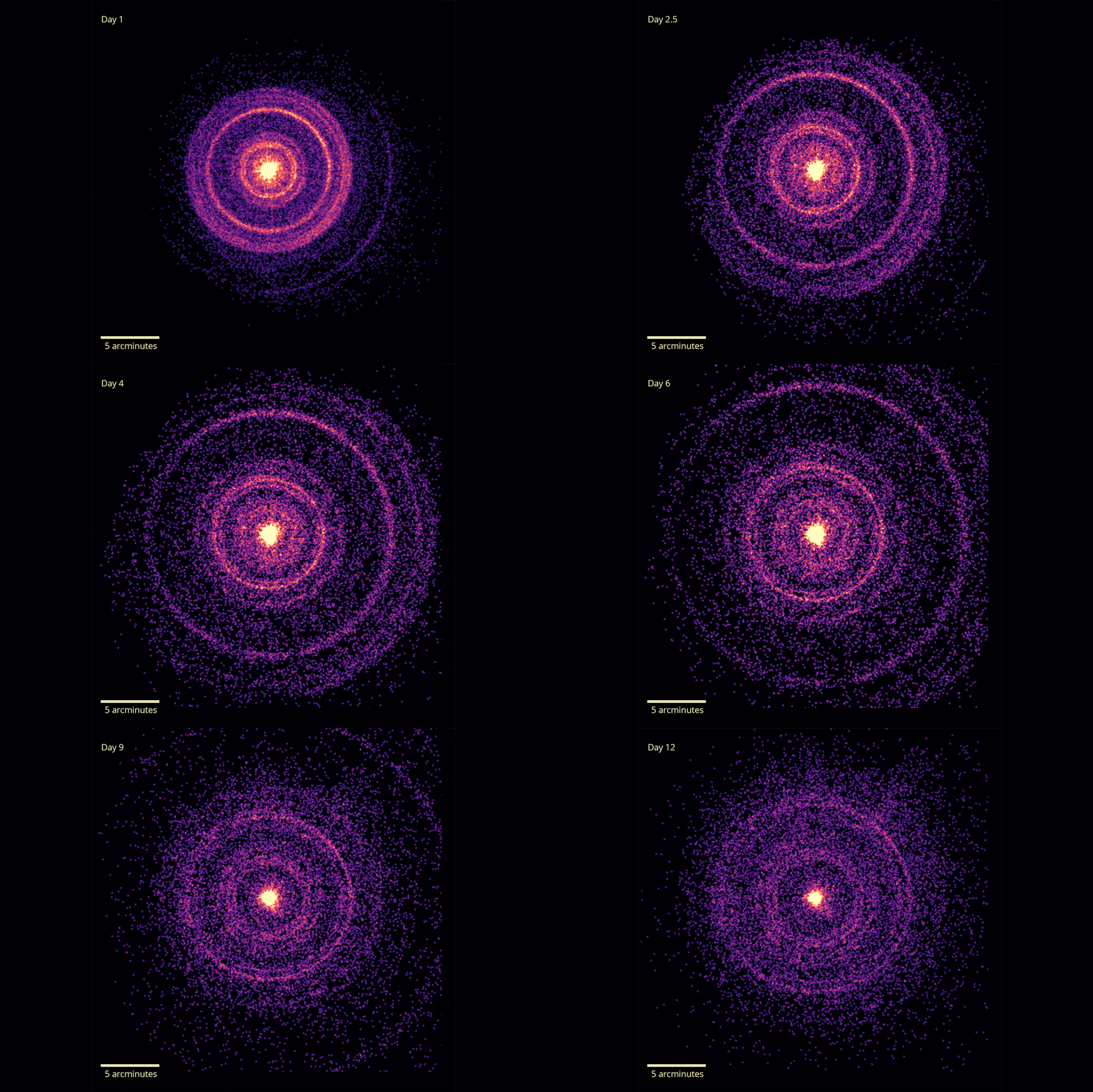
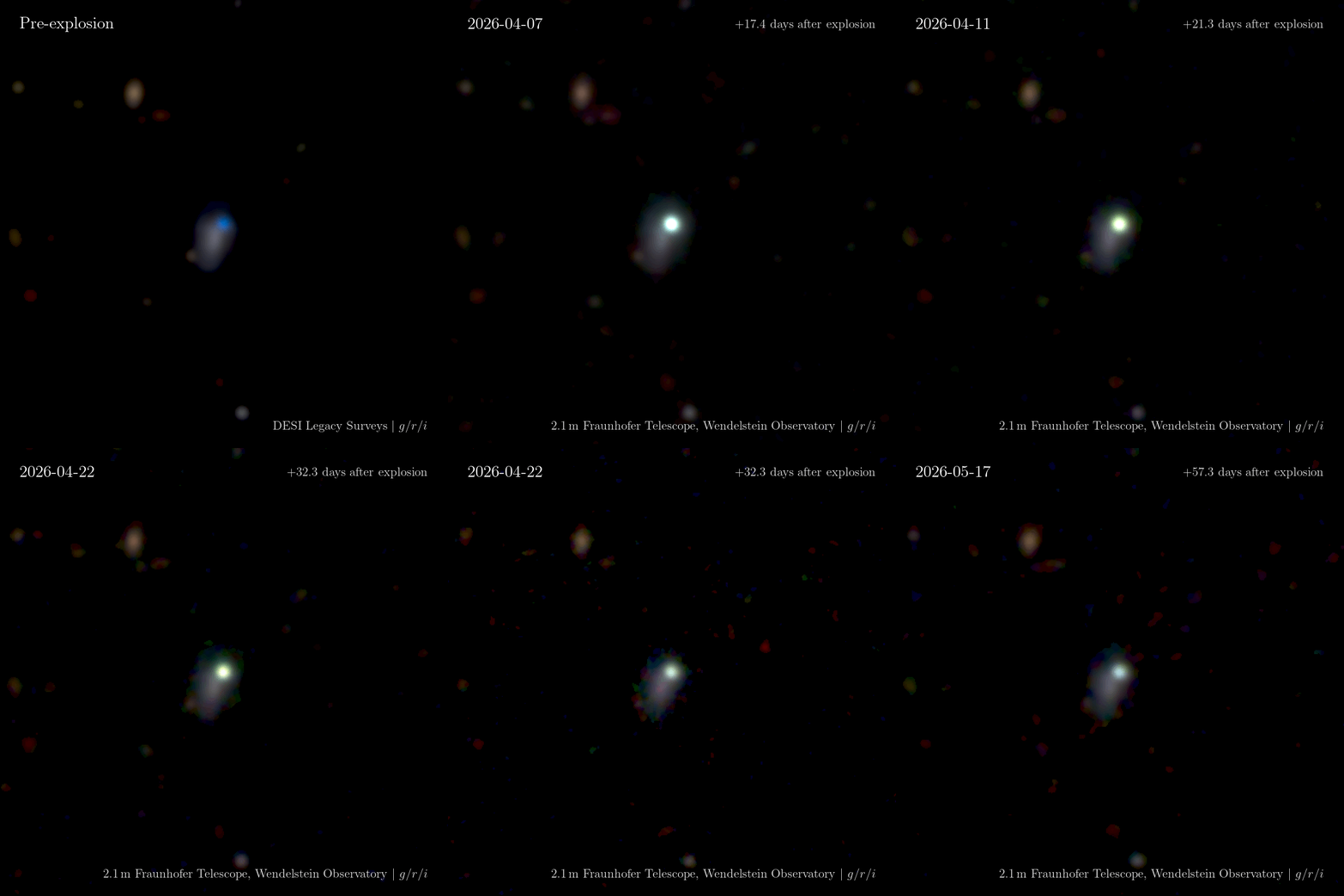
The 2024 launch of China’s Einstein Probe (EP) opened a new window on the high-energy transient Universe. Its wide-field soft X-ray survey is uncovering a previously poorly explored population of low-luminosity explosions that radiate predominantly in X-rays rather than gamma-rays. Earlier generations of high-energy transient satellites lacked the sensitivity and wide-field soft X-ray coverage needed to detect these events in large numbers.
EP is revealing a broader continuum of stellar explosions than the population historically traced by gamma-ray bursts. These observations are uncovering weak and choked jets that were largely missed by previous generations of high-energy observatories.


Contact
Joint Space-Science Institute
Department of Astronomy
University of Maryland College Park

Credit: M51/Lowell Discovery Telescope/B. O'Connor